
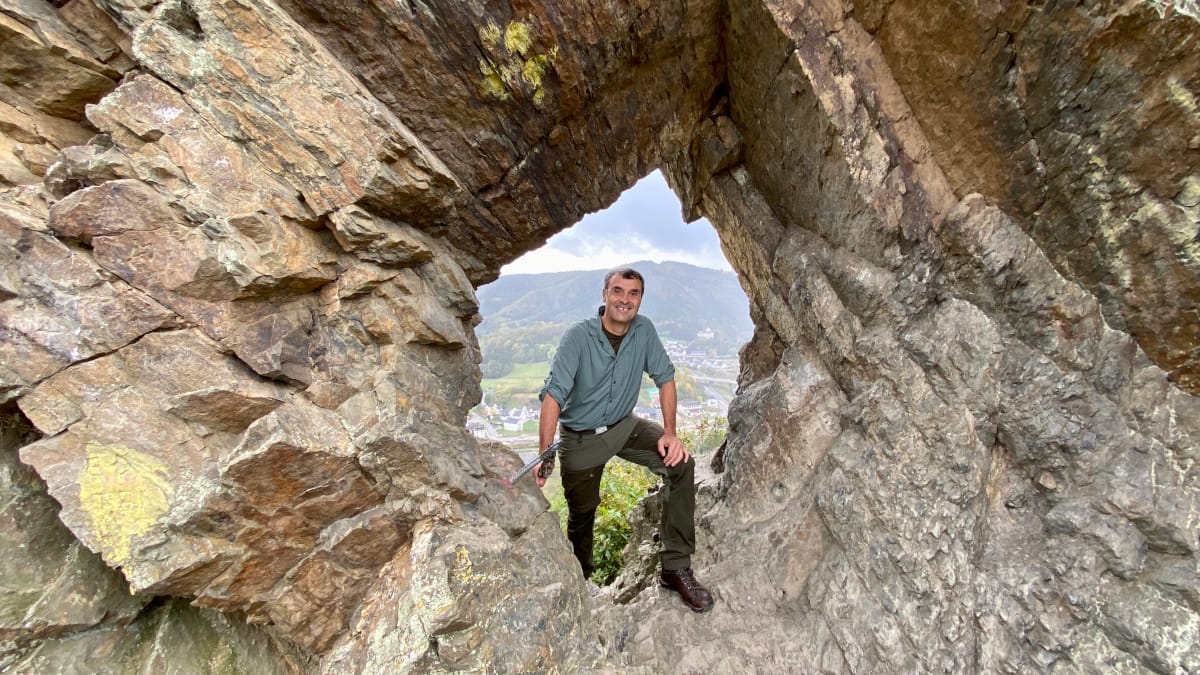
Teufelsloch Altenahr © DeWandelaar
About DeWandelaar
My writing alias and trail name is DeWandelaar. I enjoy solo multi-day hiking long-distance trails in Germany between April and September where I tent or bivouac in Schutzhütte close to nature and attempt to be as self-sufficient as possible.
Over winter I plan hikes, create accurate GPX files with information for multi-day hikers, and update this website. I share these GPS-tracks freely under the Creative Commons CC BY-NC-SA non-commercial use license.
Introduction
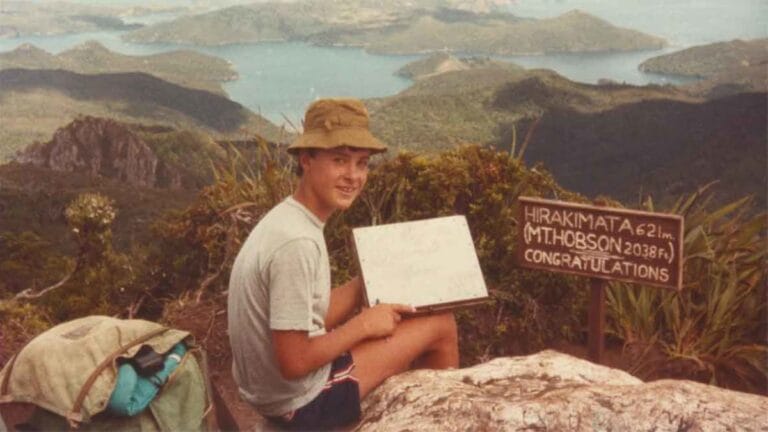
I have been hiking since before I can remember, although in the early days, I would have been a passenger in the 1950s canvas, externally framed, leather-strapped backpack you see in the photo. The image was taken in the early 1980s on the summit of Hirakimata or Mount Hobson, the highest peak on Great Barrier Island, which sits at the entrance to the Hauraki Gulf and Auckland.
It was a different time. We sailed there in a Kauri coastal skow from the wharf where the Greenpeace Rainbow Warrior had just been bombed, carried our gear in army surplus duffel bags painted with anti-nuclear ‘ban the bomb’ peace symbols. The roads were gravel, we boiled water from streams and made ‘Billy Tea’, a type of tea made from the leaves of the Manuka bush. There was one telephone and store miles away in Port Fitzroy, and World War Two vintage Grumman Goose seaplanes still serviced the island. I still have that hat, faded and unwearable now, but still take it with me on my travels. It has become a tradition that connects me to a different Heimat.
I walked many trails and climbed mountains and volcanoes in New Zealand before serendipity or zemblanity led me to The Netherlands. Although I’ve hiked many long-distance hiking trails or train station-to-station day hikes in The Netherlands, I often long for and escape into wilderness, away from the sights and sounds of civilisation, to be alone for a while and to stand on the occasional promontory that gives a view into the distance. So, in 2022, when my children were becoming old enough to look after themselves, I decided to start wandering German trails, beginning with the Rothaarsteig.
German Long Distance Trails
Because of my ancestry and ability to understand the language, I appreciate the rich history and culture of Germany, and enjoy a sense of easy familiarity as I wander along the trails.
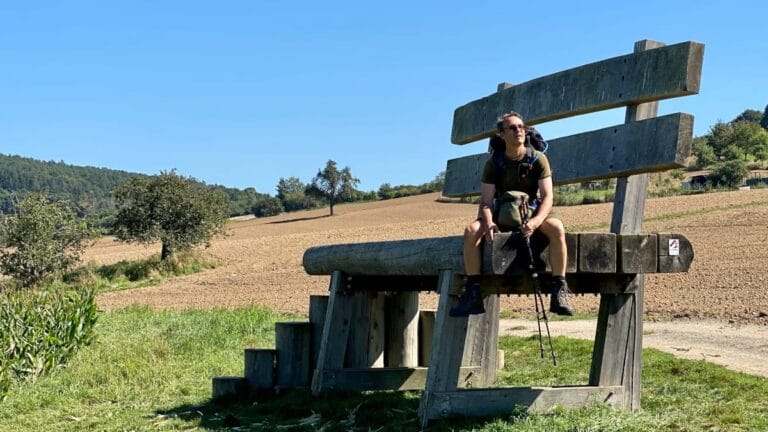
The time I have had to hike was limited to two weeks, perhaps twice a year, but now that my children are leaving home, this might increase. I travel to and from the trail from Amsterdam by train using the marvellous Deutschland Ticket. With trail difficulty in mind, I usually manage 30-50km per day (sometimes I exceed 60km), so the trails I have been considering are up to 400km in length.
I like to explore Germany at the same time I hike and might combine several trails in different regions consecutively. For example, at the beginning of September 2024 I hiked the Soonwaldsteig, Pfälzer Waldpfad, Seensteig and Donauberglandweg on one excursion – 373km in total – returned to Amsterdam, then hiked the 166km Hermannsweg before the end of the month, bringing the total that month to over 500km in just over two weeks of hiking.
Depending on the time I arrive, I usually start immediately or stay in accommodation. I certainly stay in a hotel or hostel at the end and treat myself to a moment on a biergarten and a traditional dinner. I relish the ‘luxury’ of rediscovering modern conveniences like electricity and a bed, and of course, hot water to have a good wash or soak before I catch the train back.
Solo Multi-day Hiking
I’ve always enjoyed traveling alone, especially when I want to engage in immersive or restorative moments in nature. Hiking is no different, and I like the freedom of doing what I want, at my pace, changing plans as the conditions present themselves, and not having to worry about anyone other than myself. It also gives me plenty of time to think and I enjoy contemplating ‘lived’ philosophy.
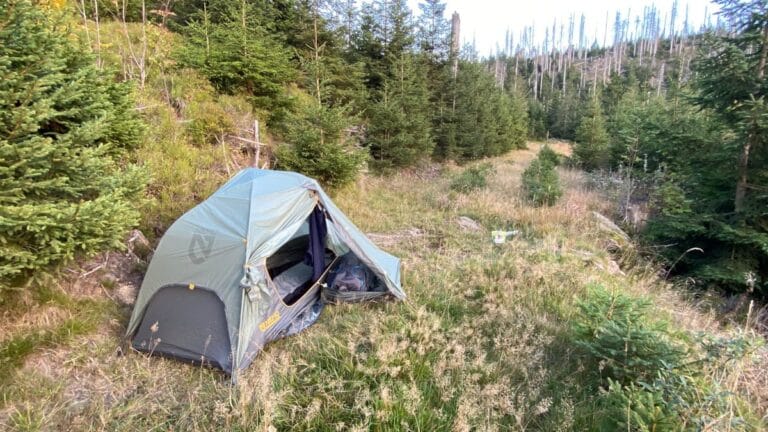
Solo multi-day hiking means I walk a trail alone, from start to finish, carrying everything I need with me, including food, shelter, and water equipment. Many of my hikes are short enough not to require resupply meaning I am self-sufficient from beginning to end. While underway, I almost always camp in a tent or bivouac, and overnight in trail side huts or Schutzhütten, trying as much as possible to steer clear of civilisation. Water is often filtered from wherever I can find it, and I mark supermarkets and other resupply points on my GPX files to keep carried weight low.
Multi-day Hiking Gear
Part of the fun in self-sufficient multi-day hiking is planning what to take and balancing this with the weight that can be carried. Thankfully, hiking equipment has become lighter over the years, a blessing as I grow older. My hiking gear still includes equipment I was using in the 1990s when I travelled from New Zealand, but in recent years I’ve been upgrading my gear with ultralight equipment to keep my base weight down. Food and calories are also an important consideration, and water management can be critical.
Family and old friends in New Zealand also still enjoy hiking and ‘roughing it’. We often share our hilarious schadenfreude hiking stories from opposite sides of the world. The discussions also involve the more serious aspects of how to make our journeys more comfortable and successful in our advancing age, and I’d like to develop a section on the website dedicated to the topic of multi-day hiking gear and my experiences with it.

The Name & History of ‘DeWandelaar’
The Dutch word ‘Wandelaar’ can be translated to the ‘Hiker’, ‘Walker’, or ‘Wanderer’.
In 2001, after some time abroad, I spent some months travelling around New Zealand and kept bumping into the story of Alfred Hamish Reed, an author and original long-distance hiker known as ‘The Happy Wanderer’. He walked what is roughly the 3000km Te Araroa trail in 1960, at age 85, carrying his gear in a swag, a tied up piece of cloth. A walker like this was known as a ‘swagman’, as in the Australian song from 1895, ‘Waltzing Matilda’. Reed continued to walk into his 90s, and I loved that spirit and freedom. A silhouette of a photo of him on that walk, waving to the photographer, is what I use as a logo.
I bumped into his memory again when I read the book ‘New Zealand in the Twentieth Century’ by Paul Moon. In that book, he writes, ‘Reed’s New Zealand was also a gentle, harmonious, unruffled Arcadian country that was already falling fast from sight… He captured the last moments of a more innocent – or at least more easily satisfied and less cynical – nation’. That passage stuck with me, particularly the idea of cynicism. I had watched parts of New Zealand disappear as they became swallowed by globalisation and neoliberal values after the 1980s, but I also remembered the period where materialism had yet to take root and with it a pervasive existential discontent.
I registered the dewandelaar.nl domain in 2012, not exactly sure what I would do with it. In 2013, I started a New Zealand wine shop with another Kiwi in Amsterdam, and we used the name DeWandelaar and logo. I transferred that business to another owner in 2015 – a long story – but kept the name. Some time later I registered the dewandelaar.org and derwanderer.de domains before deciding to use them for a long-distance hiking website 2023/24.
Conservation
Growing up next to and spending a lot of time in the New Zealand bush gave me an affinity for conservation. The 1970s and 80s were a time of intense campaigning and protesting on a range of social and environmental topics in New Zealand, and I think the ethos of that era is deeply ingrained in my personality. I was involved with Greenpeace and Friends of the Earth back then, volunteered with the Department of Conservation, and remain a lifetime member of the New Zealand Forest and Bird Society and Heritage New Zealand as well as supporting Vogelbescherming (Bird-Protection) and Natuurmonumenten (Nature-Monuments) in The Netherlands.
I conduct my personal activities and those related to DeWandelaar as environmentally conscious and sustainable as possible, always seeking ways to improve. For example, this website is built to minimize its environmental impact. I strive to keep the pages as light as possible to reduce storage and energy requirements. Additionally, I regularly remove digital ‘waste’ that is no longer needed. This includes old images and posts on social media that can accumulate in data centers and require energy to store.
Website, Data, Social Media & AI
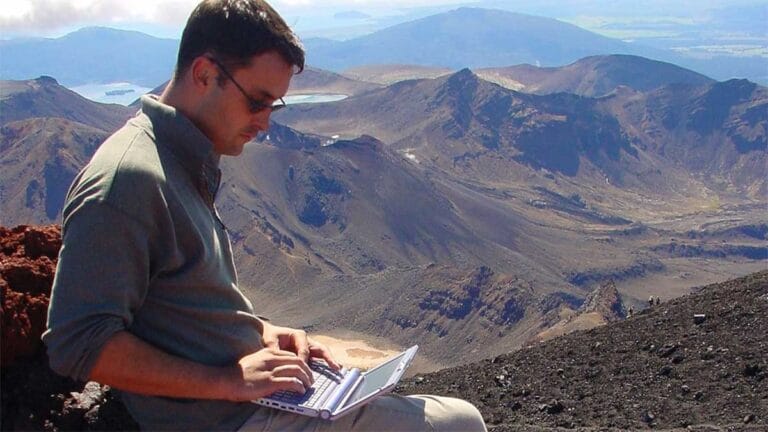
Everything you see here is created by one person, DeWandelaar. Where I have used third-party content, I make every effort to reference and attribute the source either on the page or within the content.
I develop this website over winter and spend much of the other seasons outdoors, only updating with minor updates. I often face interruptions that cause delays, and occasionally content becomes out-of-date or the website breaks. Because the website is “hand-made”, I make mistakes. Please contact me if anything requires correcting.
I’m not a regular social media user, so there can be long periods of silence on the DeWandelaar.Org Facebook page. I try to update it with website news and check it periodically; however, the contact form is the best way to get in touch.
I provide a version of the English website in German and Dutch for family, friends and visitors from those countries. I use AI to help translate the English version found on DeWandelaar.Org.