

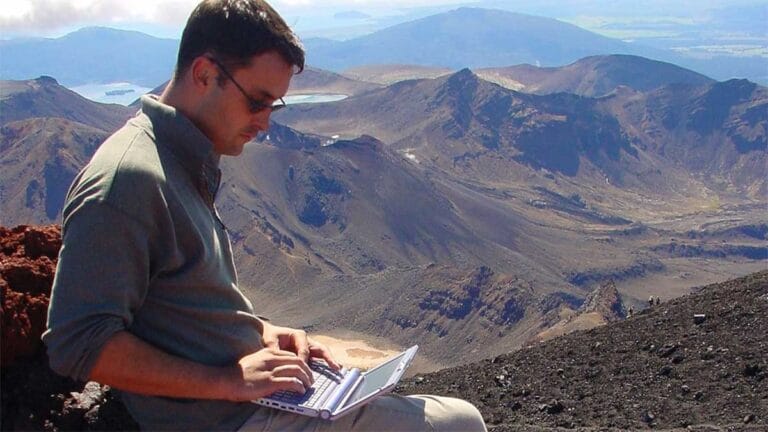
Ngauruhoe 2001 © DeWandelaar
Maps & GPX Files
High-quality GPX files are essential for safe and confident navigation on long-distance hiking trails. Unfortunately, many GPX downloads found online are outdated, incomplete, or inaccurately drawn.
For that reason, I create my own accurate GPX tracks for long-distance trails in Germany, adding carefully verified routes and practical WayPoints for multi-day hikers — including shelters, water sources, resupply points, and public transport connections.
Website Hiking Maps
Each long-distance trail page includes an interactive hiking map designed to help you plan before starting your trek.
A map like the one below may include:
- An elevation profile chart
- The official main trail route
- Optional variations and detours
- Highlighted points of interest (POIs)
- Start and end markers
The dark-green line represents the official trail. Other colored lines (light green, red, blue) show optional routes or unofficial variations. A green dot marks the start; a red dot marks the finish.
Below the map, an elevation chart displays altitude across the entire main route.
Both the map and elevation profile are interactive:
- Zoom in/out
- Hover or swipe chart to see altitude and distance at any point
- Tap trail highlight icons for additional information
- View full screen
These website maps closely match the downloadable GPX file and what you will see in a GPS app using OpenStreetMap tiles.
Main Trails vs Optional Variations
DeWandelaar GPX files remain faithful to official routes while improving usability for hikers.
Enhancements may include:
- Extending start/end points to the nearest train station
- Adding worthwhile short detours to major viewpoints
- Connecting nearby attractions
- Clarifying unclear route sections
Official variations are clearly marked. Occasionally, unofficial but worthwhile connectors are included if they significantly enhance the hiking experience.
This approach ensures:
- Enhanced trail experience
- Accuracy
- Practical transport access
What Is a GPX File?
A GPX (GPS Exchange Format) file is a standardized text file that stores geographic data including:
- Latitude
- Longitude
- Elevation
- Track information
- WayPoints (points of interest)
GPX files allow route data to be shared between computers, smartphones, and GPS devices.
When you open a GPX file in a GPS app, it displays your position relative to the track, allowing real-time navigation during a hike.
How GPS Positioning Works
GPS (Global Positioning System) determines your location using signals from satellites orbiting Earth.
Your device must receive signals from at least four satellites to calculate:
- Latitude
- Longitude
- Elevation
Temporary inaccuracies may occur due to:
- Dense forest cover
- Steep valleys
- Heavy weather
- Poor satellite geometry
If your location marker drifts slightly off the GPX track, this is usually caused by satellite signal limitations — not by track inaccuracy.
Latitude & Longitude Accuracy
GPX files contain latitude <lat> and longitude <lon> coordinates, stored in decimal format. Precision depends on the number of decimal places:
- 3 decimal places = ~111m
- 4 decimal places = ~11.1m
- 5 decimal places = ~1.11m
For fast website performance, displayed maps use 4 decimal places. Downloadable DeWandelaar GPX files use 5 decimal places for higher navigation accuracy.
Elevation Data (DTM & LiDAR)
Each trackpoint also contains elevation <ele> data in meters above sea level.
Elevation values are added using a Digital Terrain Model (DTM) derived from high-resolution satellite LiDAR (laser imaging). The DTM used provides approximately:
- 20 x 30 meter horizontal resolution
- ~1 meter vertical accuracy
While small elevation variations may occur over short distances, these inaccuracies typically average out over longer distances.
GPX Tracks Explained
A Track <trk> is a sequence of Trackpoints <trkpt> forming a continuous line.
Each Trackpoint can include:
- Latitude
- Longitude
- Elevation (optional)
Below is an example of how a Track with three sequential Trackpoints is written in GPX code. Each Trackpoint has latitude, longitude, and elevation information:
<trk>
   <trkpt lat="50.44129" lon="6.59245">
      <ele>495</ele>
   </trkpt>
   <trkpt lat="50.44411" lon="6.59741">
      <ele>496</ele>
   </trkpt>
   <trkpt lat="50.44299" lon="6.5992">
      <ele>494</ele>
   </trkpt>
</trk>
More trackpoints result in a more precise representation of curves and turns — but larger file sizes.
To balance performance and precision:
- Website maps use ~80% of the full downloadable trackpoints
- Downloadable GPX files retain higher detail for real-world navigation
WayPoint
A WayPoint <wpt> represents a single location with name and optional elevation.
<wpt lat="50.41169" lon="6.79798">
  <ele>537</ele>
  <name>Chapel</name>
</wpt>
DeWandelaar GPX files include practical WayPoints, colour coded for multi-day hikers such as:
Water & Facilities:
- Spring
- Drinking water
- WC
Accommodation:
- Shelter
- Campground
- DJH hostels
Resupply:
- Supermarket
- Convenience store
I intentionally use general labels for POIs in GPX files (e.g., “Ruin” instead of a specific building name) to encourage discovery and immersion.
Important: WayPoints are guides only. Water sources dry up, shops close (especially Sundays in Germany), and shelters may be removed.
How DeWandelaar GPX Files Are Created
My GPX creation process involves:
- Downloading multiple GPX sources (including official files)
- Comparing track differences to identify errors
- Manually redrawing an optimized track
- Cross-checking with OpenStreetMap data
- Reviewing satellite imagery
- Checking official updates and trail announcements
- Field-testing while hiking the trail
- Annual updates and corrections
This layered process significantly improves reliability over many freely available GPX files.
However, manual processes always allow room for human error. If you spot inaccuracies, please contact me.
GPX files are navigation aids – not emergency guarantees. Always carry backup navigation methods and review official trail websites before hiking.
Recommended GPS Apps for Using GPX Files
Most modern GPS devices and smartphone apps support GPX files.
Features to look for:
- Offline maps
- GPX import capability
- Elevation profile display
- WayPoint visibility
- Distance-to-point tracking
I consider the offline maps feature critical, it allows navigation when mobile data signals are lost.
On iOS, I personally use GPX Viewer 2, due to its clear interface, elevation visibility, and efficient one-handed use during hiking. The developer has integrated my suggestions, and DeWandelaar GPX files are designed to display extended information like POI colour-coding within the app.
GPX Viewer 2 on Apple App Store →
Other GPS Apps I have used include;
- Maps 3D Pro
- Komoot
- OSMand
- Outdooractive
- TopoGPS
- Wikiloc.
DeWandelaar GPX files are device-independent and compatible with most GPS platforms.
Trail Summary Data Explained
Each trail page includes summary statistics derived from the GPX file:
143km
4373m
4403m
606m
Medium
22h
After updating track data, I:
- Extract summary data via GPX software
- Independently verify calculations
- Manually enter verified data into the website
Manual processes always carry small risk of error — please report discrepancies.
Difficulty & Time Estimation
Trail difficulty is calculated based on elevation gain and gradient:
- – Easy
- – Moderate
- – Strenuous
- – Challenging
- – Expert
Terrain type (asphalt, gravel, rocky paths) also influences real-world effort.
Estimated total hiking time is calculated using:
- Elevation-adjusted difficulty
- Average flat walking speed of 5 km/h
Example:
22 hours ÷ 8 walking hours/day = 2.75 days → 3 days total
Actual duration varies depending on fitness, pack weight, rest time, and weather conditions.